Pearson Edexcel · GCSE · History
Course version: 1HI0 · Version from Sept 2016
The historic environment - 1 Whitechapel, c1870–c1900: crime, policing and…
Full specification wording
Option 10: The historic environment - 1 Whitechapel, c1870–c1900: crime, policing and the inner city: The inhabitants of Whitechapel. The lack of employment opportunities and level of poverty. The prevalence of lodging houses and pubs creating a fluctuating population without ties to the community. The impact of changing patterns of migration: the settlement of migrants from Ireland and Eastern Europe, and the increase in Jewish migration during the 1880s.
Whitechapel in the late 19th century was characterised by extreme poverty and limited employment opportunities, with many residents relying on casual labour such as dock work or sweatshops.
Checked against the Pearson Edexcel 1HI0 specification (opens in a new tab) on .
- Point 2 of 5
- 3 key terms
Study notes
From the checked teaching notes for this specification point.
The idea
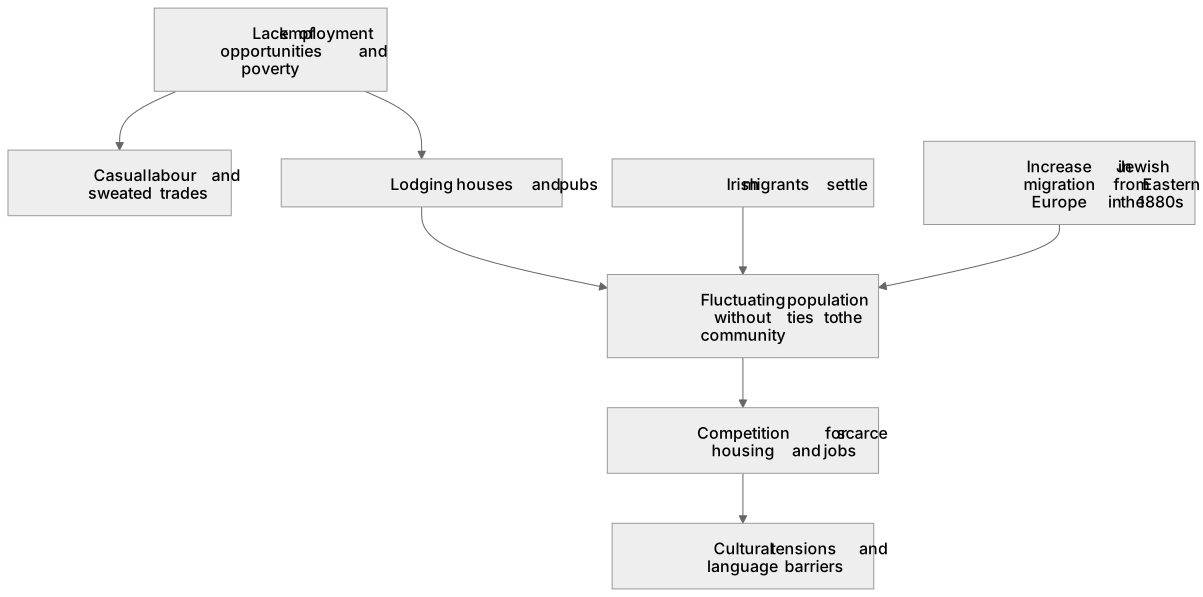
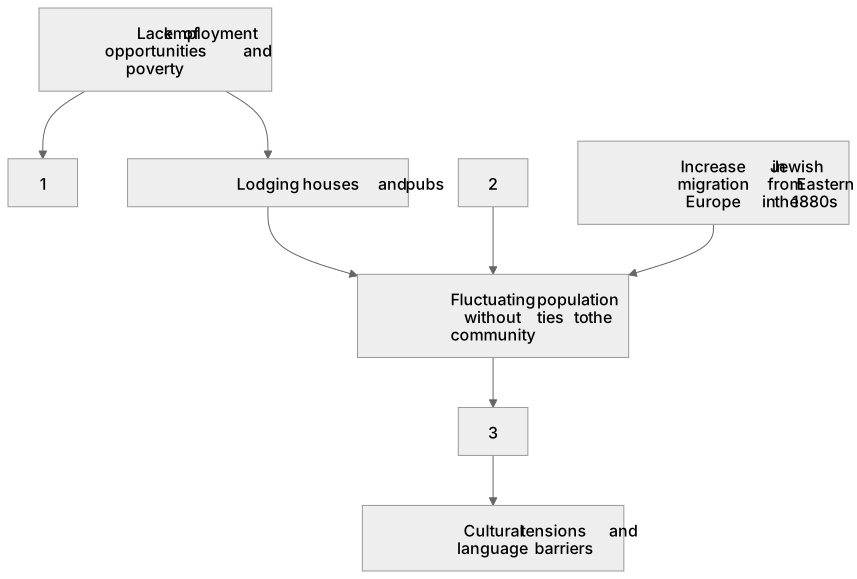
Whitechapel in the late 19th century was characterised by extreme poverty and limited employment opportunities, with many residents relying on casual labour such as dock work or sweatshops. The area was dominated by overcrowded lodging houses (doss houses) and numerous pubs, which fostered a transient, fluctuating population lacking strong community ties. This instability was compounded by changing migration patterns. Irish immigrants, fleeing poverty, settled in the area, often facing prejudice. From the 1880s, there was a significant increase in Jewish migration from Eastern Europe, escaping persecution (pogroms). These new arrivals often worked in the sweated trades, leading to cultural tensions, language barriers, and increased competition for scarce housing and jobs, further destabilising the local community.
What earns the marks
- Identify the reliance on casual labour and 'sweated trades' as key causes of poverty and lack of stable employment.
- Explain how lodging houses (doss houses) and pubs contributed to a transient population with few community ties.
- Describe the reasons for and impact of Irish migration, including the resulting anti-Irish prejudice.
- Analyse the surge in Eastern European Jewish migration during the 1880s and its effect on housing and employment competition.
- Evaluate how the combination of poverty, transient populations, and diverse migrant groups created a challenging environment for social cohesion.
Common mistakes and how to put them right
Confusing the reasons for Irish and Eastern European Jewish migration.
Put it right: Irish migrants largely came earlier to escape poverty and famine, while Eastern European Jews arrived in large numbers in the 1880s fleeing religious persecution (pogroms).
Assuming all inhabitants lived in permanent housing.
Put it right: Emphasise that a significant portion of the population lived in temporary lodging houses, paying nightly for a bed, which created a fluctuating population.
Stating there was no work available.
Put it right: Clarify that work existed but it was often casual, poorly paid, and insecure, such as dock labour or tailoring in sweatshops, rather than a complete lack of jobs.
Exam tips
- Use specific terms like 'doss house', 'sweated trades', and 'pogroms' to demonstrate precise historical knowledge.
- When discussing migration, always link the arrival of new groups to the resulting social tensions, such as competition for housing and jobs.
- Consider how the transient nature of the population made it difficult for the police to track individuals and maintain order.
Try the lesson
The start of the Option 10: The historic environment - 1 Whitechapel, c1870–c1900: crime, policing and the inner city: The inhabitants of Whitechapel. The lack of employment opportunities and level of poverty. The prevalence of lodging houses and pubs creating a fluctuating population without ties to the community. The impact of changing patterns of migration: the settlement of migrants from Ireland and Eastern Europe, and the increase in Jewish migration during the 1880s. lesson, made from checked teaching notes for this specification point.
Have a go first
Which feature of Whitechapel's housing most contributed to a fluctuating population without strong ties to the local community?
Listen
Whitechapel in the late 19th century was characterised by extreme poverty and limited employment opportunities, with many residents relying on casual labour such as dock work or sweatshops. The area was dominated by overcrowded lodging houses (doss houses) and numerous pubs, which fostered a transient, fluctuating population lacking strong community ties. This instability was compounded by changing migration patterns. Irish immigrants, fleeing poverty, settled in the area, often facing prejudice. From the 1880s, there was a significant increase in Jewish migration from Eastern Europe, escaping persecution (pogroms). These new arrivals often worked in the sweated trades, leading to cultural tensions, language barriers, and increased competition for scarce housing and jobs, further destabilising the local community. A strong answer earns marks for these points. Identify the reliance on casual labour and 'sweated trades' as key causes of poverty and lack of stable employment. Explain how lodging houses (doss houses) and pubs contributed to a transient population with few community ties. Describe the reasons for and impact of Irish migration, including the resulting anti-Irish prejudice. Analyse the surge in Eastern European Jewish migration during the 1880s and its effect on housing and employment competition. A common slip: Confusing the reasons for Irish and Eastern European Jewish migration. Instead, Irish migrants largely came earlier to escape poverty and famine, while Eastern European Jews arrived in large numbers in the 1880s fleeing religious persecution (pogroms). Exam tip: Use specific terms like 'doss house', 'sweated trades', and 'pogroms' to demonstrate precise historical knowledge.
See it
Key words
Say what each word means before you turn the card.
Poverty and wealth
Try answering aloud or in your head before turning the card.
Migration and community
Try answering aloud or in your head before turning the card.
Employment and economy
Try answering aloud or in your head before turning the card.
See every definition
- Poverty and wealth
- The inhabitants of Whitechapel faced a level of poverty linked to the lack of employment opportunities.
- Migration and community
- Changing patterns of migration included the settlement of migrants from Ireland and Eastern Europe, and an increase in Jewish migration during the 1880s.
- Employment and economy
- The lack of employment opportunities was a feature of the area, with many residents relying on casual labour such as dock work or sweatshops.
Label the diagram
Some boxes have lost their names. Pick the right name for each number.
1Box 1
2Box 2
3Box 3
There is more to this lesson
The full lesson goes on to check your understanding and help you earn the marks. Create a free account to carry on, with your progress saved.
A week of Premium from your first lesson · Then the free plan continues · No card, no charge
Test your understanding of Option 10: The historic environment - 1 Whitechapel, c1870–c1900: crime, policing and the inner city: The inhabitants of Whitechapel. The lack of employment opportunities and level of poverty. The prevalence of lodging houses and pubs creating a fluctuating population without ties to the community. The impact of changing patterns of migration: the settlement of migrants from Ireland and Eastern Europe, and the increase in Jewish migration during the 1880s.
Active recall beats re-reading. Take an instant quiz now to test what you’ve learned and lock it into long-term memory.
A week of Premium from your first lesson · Then the free plan continues · No card, no charge